How to Choose an Industrial Gear Motor in 2026?

Time:2026-09-14 Author:Ethan
0%

Choosing an Industrial Gear Motor in 2026 is a performance and risk decision, not merely a purchasing exercise. Electric motor systems consume roughly half of global electricity, according to the International Energy Agency. In industrial facilities, their energy impact is even more significant. A poorly matched gearbox can waste power, increase heat, and shorten bearing life. Small errors become expensive.

Market forecasts also show continued demand for compact, efficient drive systems. Fortune Business Insights projects steady growth in the global gear motors market through 2032, while MarketsandMarkets expects expanding adoption across automation, material handling, packaging, and process equipment. These reports use different market definitions and assumptions. That matters. A forecast is guidance, not certainty.

This article introduces a practical method for selecting the right unit in 2026. Start with the application’s actual load, not the motor’s nameplate power. Record required torque, output speed, duty cycle, starts per hour, shock loads, ambient temperature, and mounting position. For example, a conveyor carrying wet cartons may need higher starting torque and stronger sealing than its daily average suggests. Check gearbox service factor, motor efficiency, brake requirements, inverter compatibility, noise, and maintenance access. IEC 60034 efficiency classifications and ISO 10816 vibration guidance can support a more defensible comparison. Still, standards do not replace field experience. I have seen apparently identical drives behave differently after dust, misalignment, or frequent reversing. The best selection balances efficiency, controllability, lifecycle cost, and realistic operating conditions. Guesswork remains tempting. It should not lead the specification.
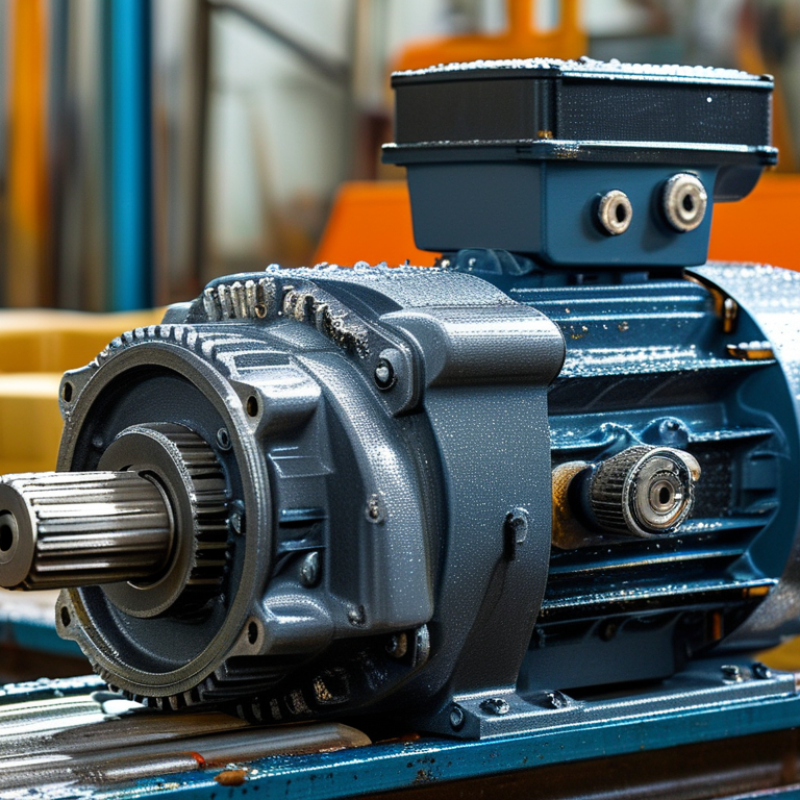
How to Choose an Industrial Gear Motor in 2026?

Calculate Required Torque and Speed with T = 9550P/n

Choosing an industrial gear motor in 2026 starts with measured torque, not catalog size.
T = 9550P/n
Here, T means torque in newton-metres, P means mechanical power in kilowatts, and n means speed in revolutions per minute.
A 7.5 kW motor turning at 1,450 rpm produces approximately 49.4 Nm before reduction.

Suppose a conveyor needs 300 Nm at 50 rpm. Its ideal power is 1.57 kW, using P = Tn/9550. Real selection must include gearbox efficiency, acceleration, shock loading, and daily starts.

With 90% efficiency and a 1.5 service factor, the motor requirement rises to about 2.62 kW. That result is useful, but not sacred. A sticky belt can defeat a neat calculation.

The U.S. Department of Energy’s 2021 Industrial Motor Systems Market Assessment reports that motor-driven equipment uses about 68% of electricity in U.S. manufacturing. The IEA’s Energy Efficiency 2023 report also identifies motor systems as a major industrial efficiency opportunity.

Check duty cycle and heat, not only rated watts.
Measure shaft speed with a tachometer.
Record peak current during startup.
Confirm radial loads, mounting position, enclosure rating, and brake requirements.

I would leave thermal margin in dusty or hot rooms. A 29:1 ratio approaches 50 rpm from 1,450 rpm, but the process should decide the ratio.

Match Gear Ratio, Duty Cycle, and Service Factor to IEC 60034-1

How to Choose an Industrial Gear Motor in 2026?

Selecting an industrial gear motor starts with the driven machine, not the catalog. Record required output speed, continuous torque, peak torque, starts per hour, and ambient temperature. A 30 rpm conveyor may need steady torque, while a mixer can demand repeated overloads. Calculate the gear ratio from motor speed to working speed. Then check whether the reducer can transmit the actual torque without excessive heat.

Duty cycle must match the application. IEC 60034-1 provides a framework for motor ratings, operating conditions, temperature rise, and performance verification. Continuous duty is not equivalent to frequent starting, braking, or fluctuating loads. Use the applicable duty classification and confirm the motor’s rated output under those conditions. Small details matter. A motor running in a dusty, hot enclosure may deliver less practical capacity than its nameplate suggests.

Service factor should provide realistic protection, not hide poor sizing. Consider shock loads, starts, misalignment, and future production changes. A factor of 1.15 may be reasonable for a stable conveyor, but it may be inadequate for a crusher or indexing machine. Do not apply one number blindly. In field selection, I have seen oversized motors waste energy and undersized units overheat during startup. A neat spreadsheet can still mislead. Verify acceleration time, brake behavior, shaft loads, and thermal limits with measured or manufacturer-published data. Allow room for uncertainty, but question every margin.

Select IE3 or IE4 Motor Efficiency Classes Under IEC 60034-30-1

How to Choose an Industrial Gear Motor in 2026?

Selecting an industrial gear motor starts with the motor’s actual operating conditions, not its catalog rating. IEC 60034-30-1 defines efficiency classes for many line-operated AC motors, including IE3 and IE4. IE3 motors provide high efficiency with broad availability and familiar maintenance practices. IE4 motors reduce electrical losses further, especially during long operating hours and steady loads.

Check the motor’s rated power, speed, duty cycle, ambient temperature, and starting method. A conveyor running 20 hours daily may justify IE4, even with a higher purchase price. A lightly used mixer may not. Measure the load at the gearbox output, not only at the motor shaft. Gearbox losses, lubrication, misalignment, and oversized motors can erase expected savings. Small details matter.

Do not treat IE4 as automatically better. IEC efficiency values depend on the tested motor conditions, while the complete gear motor operates through gears, seals, and sometimes a drive. Confirm the declared efficiency, test method, voltage, frequency, and operating point. Local energy rules may also set different minimum requirements. A neat spreadsheet can still mislead. I would leave thermal and service margins, but avoid excessive oversizing. In practice, the best choice balances efficiency, torque, start-up demand, enclosure protection, maintenance access, and lifetime energy cost. Check the nameplate and technical file before approval.

Choose IP55 or IP66 Enclosures According to IEC 60529

How to Choose an Industrial Gear Motor in 2026: IP55 or IP66 Under IEC 60529

When selecting an industrial gear motor, enclosure protection deserves careful attention. IEC 60529 defines the meaning of IP ratings. IP55 provides protection against limited dust entry and water jets from any direction. IP66 offers complete dust protection and stronger water-jet resistance. Neither rating permits continuous immersion. That distinction is often missed.

For dry indoor production areas, IP55 may provide practical and economical protection. It can handle airborne dust and occasional cleaning. For food, chemical, or outdoor sites, IP66 is usually more suitable. Frequent washdown can force water toward seals, cable entries, and inspection covers. A robust housing helps, but it cannot repair poor installation. IP66 also does not automatically protect against corrosion, high temperature, or aggressive chemicals.

Check the complete assembly, not only the motor label. Inspect cable glands, connectors, drain plugs, and mounting surfaces. One loose gland can reduce real-world protection. Match the gear motor’s torque, speed, duty cycle, and ambient temperature with the application. Request test documentation showing the applicable IEC 60529 method. Do not treat an IP code as a guarantee for every environment. In plant inspections, damaged cables often create more risk than the original enclosure. That small oversight deserves more attention.

Verify Thermal Rating, Lubrication, Noise, and 2026 Compliance

How to Choose an Industrial Gear Motor in 2026?

Thermal rating deserves more attention than peak torque. The IEA estimates motor-driven systems consume about 46% of global electricity. Small efficiency losses become expensive across continuous production. Check rated torque, duty cycle, ambient temperature, altitude, and enclosure class together. A gearbox may survive a brief overload, but repeated heat cycles can shorten seal and bearing life. I would not trust a catalog rating without reviewing the thermal calculation.

Lubrication should match speed, load, orientation, and operating temperature. Confirm oil viscosity, fill level, replacement interval, and food or chemical exposure requirements. A practical check is simple: inspect the housing after several hours. Excessive heat, foam, or metallic noise signals trouble. ISO 12925-1 classifications help compare industrial lubricants, but they do not replace application testing. I have seen maintenance teams overfill gearboxes, assuming more oil means better protection.

Noise measurements should reference ISO 3744 or an equivalent acoustic method. Ask for sound-power data, not vague “quiet operation” claims. The U.S. Department of Energy reports that motor-driven equipment can exceed half of industrial electricity use, so efficiency and compliance deserve equal scrutiny. For 2026 projects, verify applicable IEC 60034 efficiency requirements and local ecodesign rules, including IE-class limits where relevant. Requirements differ by market. That detail is easy to miss. Record certificates, test conditions, and deviations before purchase.

FAQS

What information should I collect before choosing an industrial gear motor?

Record output speed, continuous torque, peak torque, starts per hour, and ambient temperature.

How do I calculate the required gear ratio?

Divide motor speed by the machine’s required working speed.

How should duty cycle affect gear motor selection?

Match the motor rating to actual operation.

What service factor is suitable for an industrial gear motor?

Use a realistic margin for shock loads, starts, misalignment, and future changes.

Should I choose IE3 or IE4 efficiency?

IE3 offers high efficiency and broad availability. IE4 can reduce losses further.

Why can a highly efficient motor still waste energy?

Gearbox losses, lubrication, misalignment, and oversizing can erase expected savings.

When should I choose IP55 or IP66 protection?

IP55 suits many dry indoor areas with airborne dust and occasional cleaning.

What installation details can reduce real enclosure protection?

Inspect cable glands, connectors, drain plugs, inspection covers, and mounting surfaces.

What should I verify before approving the gear motor?

Confirm acceleration time, brake behavior, shaft loads, thermal limits, and enclosure conditions.

Conclusion

Choosing the right Industrial Gear Motor in 2026 starts with accurately defining the application’s torque and speed requirements. Use the formula T = 9550P/n to estimate torque from power and rotational speed, then select a suitable gear ratio for the required output. The motor should also match the expected duty cycle and include an appropriate service factor in line with IEC 60034-1, helping it handle starting loads, frequent operation, and demanding working conditions.

Energy performance is another key consideration. IE3 or IE4 efficiency classes under IEC 60034-30-1 can reduce operating losses and support long-term energy management. Choose an IP55 enclosure for standard industrial environments or IP66 when protection against dust and powerful water jets is necessary, according to IEC 60529. Before final selection, verify thermal capacity, lubrication intervals, operating noise, mounting requirements, and documentation confirming compliance with applicable 2026 requirements. A complete evaluation improves reliability, efficiency, maintenance planning, and overall equipment performance.

Ethan

Ethan

Ethan is a seasoned marketing professional with a deep expertise in our company's innovative product line. With a passion for sharing knowledge and insights, he takes the lead in regularly updating our corporate blog, where he explores industry trends, product features, and effective marketing......